
What are nanoparticles?
Nanoparticles are particles with a size between 1 and 100 nanometers (nm).
- 1–100 nm → Nanoparticles
- Above 100 nm → Macro particles
- Much smaller than 1 nm → Atomic/Molecular scale
Nanoparticles have a large surface area
particle size decreases
surface area increases
Reactivity increases
Biological activity increases
Methods of nanoparticle synthesis
There are two common methods.
1. Chemical synthesis
- Uses chemicals and metal salts.
- One common method is co-precipitation.
- The reaction mechanism is easy to understand and control.
Disadvantages
- Can be toxic.
- In biomedical applications, it may damage healthy (normal) cells along with diseased cells.
2. Green synthesis
- Uses plant extracts to prepare nanoparticles.
- Plant extracts contain natural compounds (phytochemicals) that help reduce metal ions into nanoparticles.
Advantages
- Eco-friendly.
- Less toxic.
- Better for biomedical applications.
Limitation
Plant extracts contain many different bioactive compounds, so it is difficult to determine exactly which compound is responsible for nanoparticle formation.
Major Synthesis Approaches
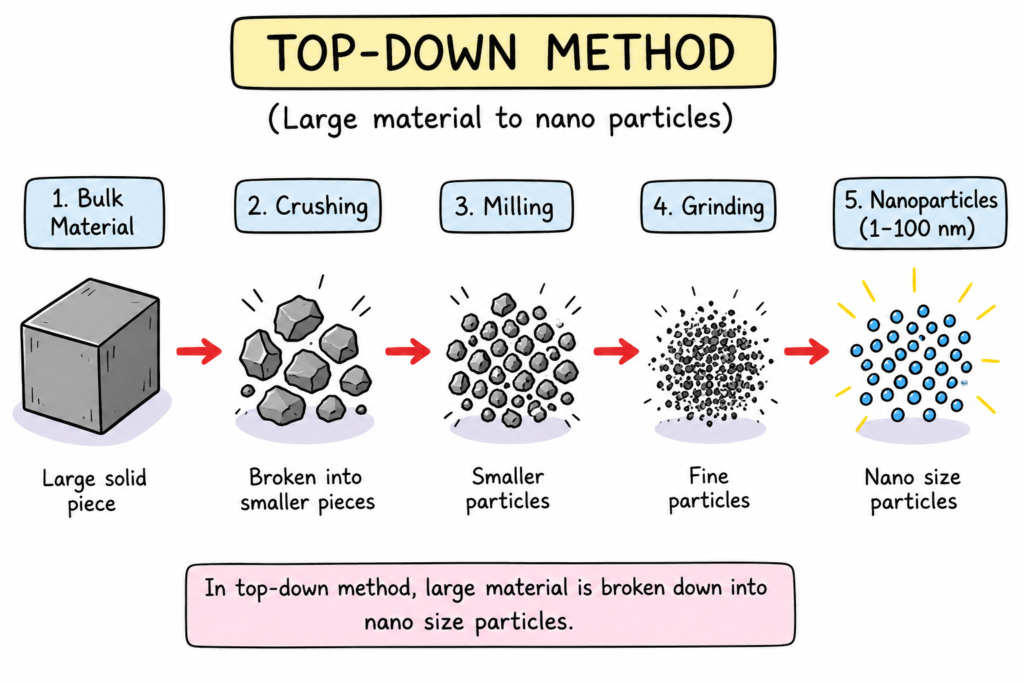
Top-down
Large materials are broken down into nanosized particles.
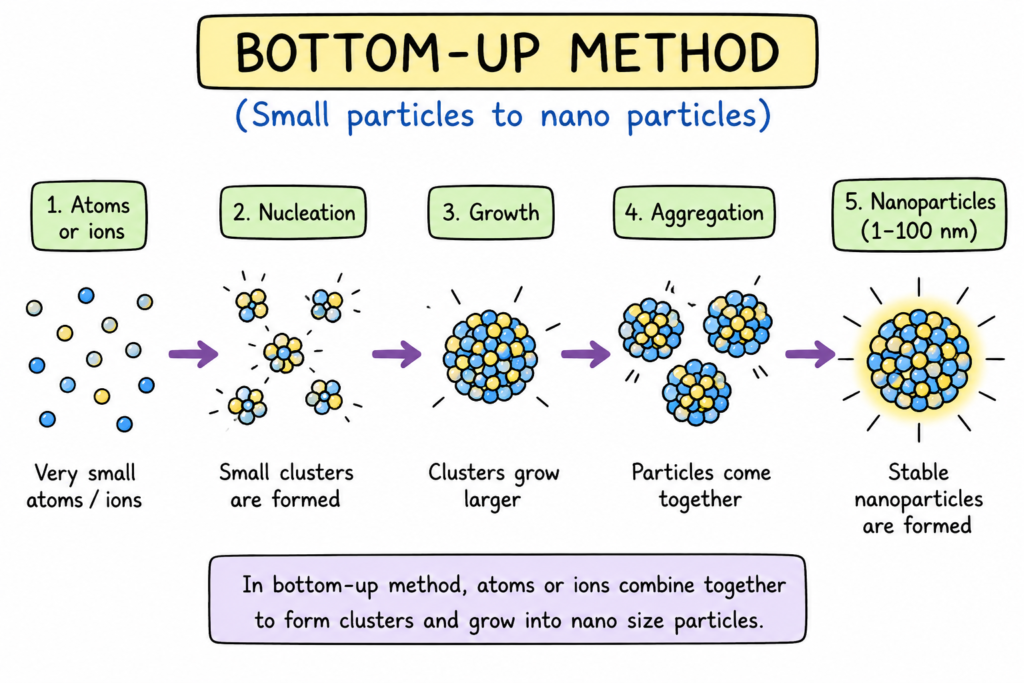
Bottom-up
Nanoparticles are built by combining atoms or molecules.
Characterization techniques
Characterization means studying the physical and chemical properties of nanoparticles.
1. XRD (X-Ray Diffraction)
Purpose:
- Confirm nanoparticle formation.
- Identify crystal structure.
- Detect impurities.
- Calculate crystal size.
How it works:
- X-rays hit the sample.
- The sample diffracts the X-rays.
- The machine records peaks at different 2θ (two-theta) angles.
- These peaks are compared with standard JCPDS data.
- If they match, the desired nanoparticle has been successfully synthesized.
2. FTIR (Fourier Transform Infrared Spectroscopy)
Purpose:
Identify functional groups.
Examples:
- OH (Hydroxyl)
- COOH (Carboxyl)
- Alcohol
- Alkene
In green synthesis, FTIR confirms that plant biomolecules are attached to the nanoparticles.
3. UV–Visible Spectroscopy
Purpose:
- Confirm nanoparticle formation.
- Study optical properties.
- Determine the wavelength where maximum absorption occurs.
4. Photoluminescence (PL)
Purpose:
- Measure light emitted by nanoparticles.
- Estimate Reactive Oxygen Species (ROS) production.
Higher ROS production usually indicates stronger antimicrobial and anticancer activity.
5. SEM (Scanning Electron Microscope)
Purpose:
Observe particle morphology.
It shows whether nanoparticles are:
- Spherical
- Rod-shaped
- Cubic
- Well crystallized
6. EDX (Energy Dispersive X-ray Spectroscopy)
Purpose:
Determine the elemental composition.
For example, it measures the percentage of:
- Carbon
- Oxygen
- Nickel
- Zinc
7. Elemental Mapping
Purpose:
Shows the distribution of different elements using different colors.
It confirms whether all elements are evenly distributed throughout the sample.
8. TEM (Transmission Electron Microscope)
Purpose:
Provides a much higher-resolution image than SEM.
It helps determine:
- Exact particle size
- Particle shape
- Crystal lattice structure
- Individual nanoparticles